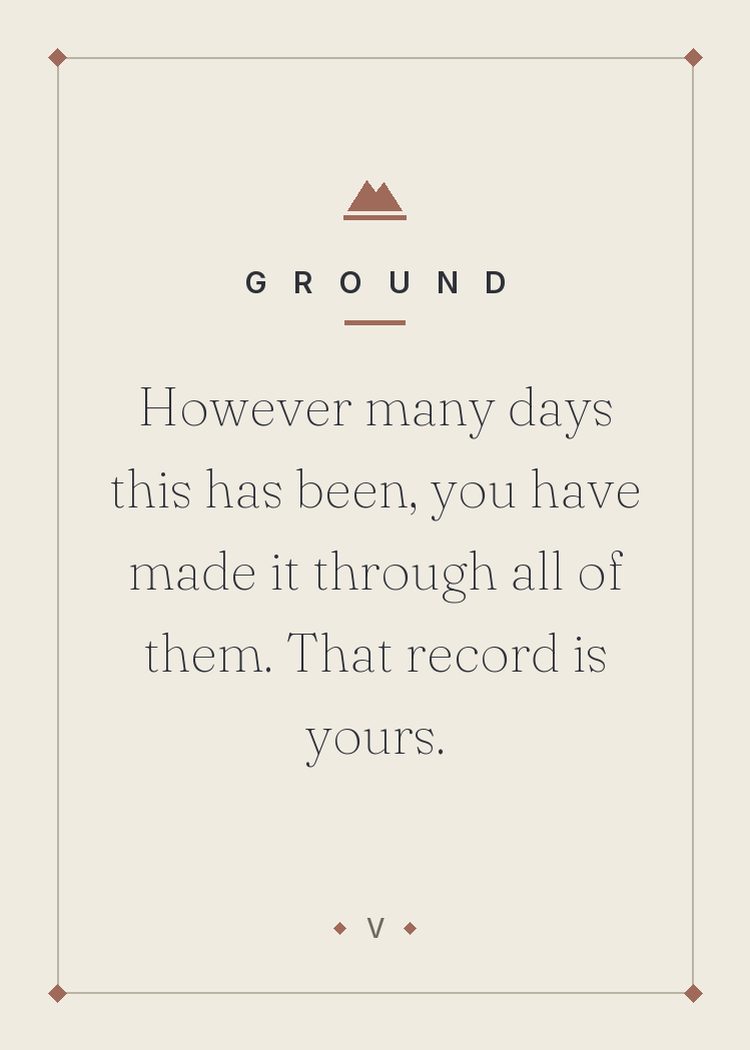
GROUND · V
Catastrophic thinking tells a grieving person they cannot survive this. The strongest counter-evidence is the record: every previous day has, in fact, been survived. Cognitive approaches to distress use exactly this move — replacing a global prediction ('I can't do this') with observable data ('I have done this, daily'). A survival streak of one hundred percent is not nothing. It is the single most reliable fact you own.
Voices — this card, in use
Teaching vignettes: illustrative voices showing the practice applied. The living candle wall grows below.
Derek — 'day 63. survival rate still 100%. I wrote it on the mirror like homework. hard to argue with your own record.'
Lena — 'when the panic says I can't do this, I say: I did yesterday, and the 200 yesterdays before it. the math holds when I don't.'
Whatever is coming up
This room is open every time — tonight, the anniversary, years from now. What's here right now?
The practice
Say the number out loud: how many days since. Then say: I have survived every one. Do the math on your survival rate. Write the percentage somewhere you'll find it on a bad day.
When it's yours
If it's early daysFourteen days survived is fourteen pieces of evidence. Early grief argues you can't do this; the record says you already are.
If it's been a long timeHundreds of days in, the streak is long enough to lean on. You are, verifiably, someone who survives this.
If it was complicatedSurviving grief for a complicated person is its own achievement — you carried weight most people can't even name.
Sit with this
What has actually gotten you through the worst day so far — the real thing, not the thing you're supposed to say?
Grief literacy
Term to know: Cognitive reappraisal — replacing a catastrophic prediction with observable evidence.
If this card holds you
This room doesn't expire. Grief isn't a one-time event — anniversaries, ambushes, the good years, the hard ones — and the card in your hand is a permanent key. Come back for whatever is coming up.
This card lives in the deck — 52 companions, on a nightstand near the people you love. Buy the physical deck — $35.00 · free US shipping