FEEL · XI
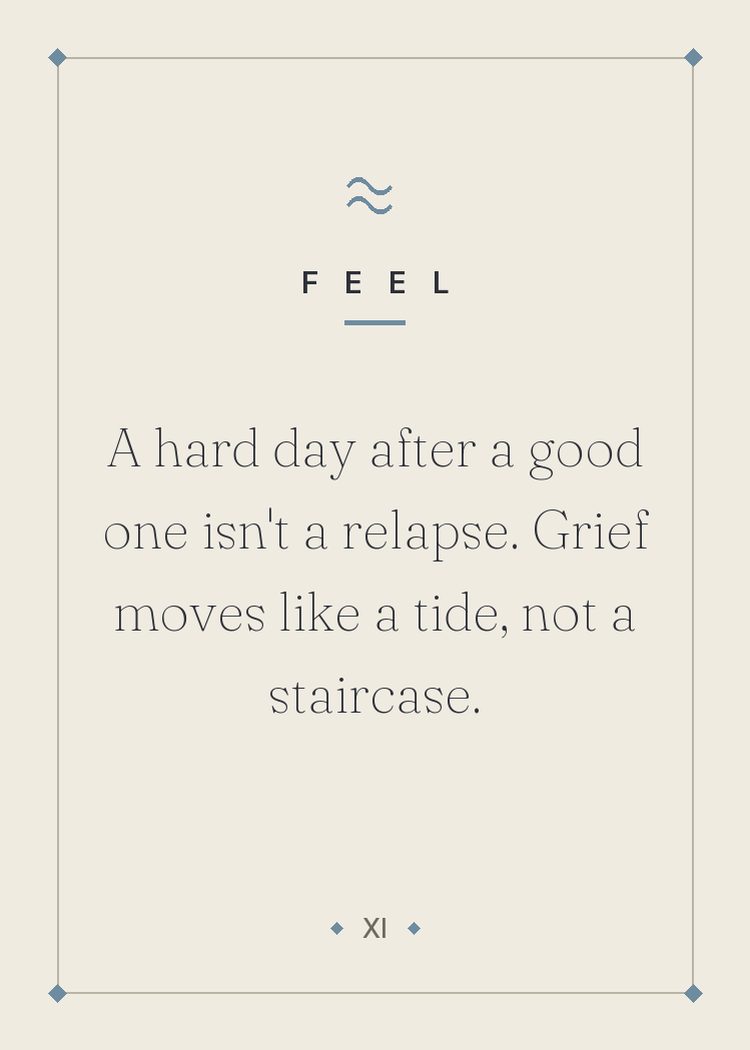
Kübler-Ross's five stages were developed from interviews with dying patients, not bereaved ones — and decades of research since, especially Bonanno's trajectory studies, show grief follows no fixed sequence. It moves like a tide: in, out, in again, with hard days after good ones as part of the pattern, not regression against it. Retiring the staircase removes a cruel yardstick. There is no stage you are behind on.
Voices — this card, in use
Teaching vignettes: illustrative voices showing the practice applied. The living candle wall grows below.
Iris, 63 — 'someone asked what stage I was in. I said tide. hard month in year two wasn't relapse, it was water. it went back out.'
Leo — 'fired the five stages like the card said. felt insubordinate and correct. there is no schedule I'm behind on. there never was.'
Whatever is coming up
This room is open every time — tonight, the anniversary, years from now. What's here right now?
The practice
Formally fire the five stages: say 'I am not behind, because there is no schedule.' Replace the staircase image with a tide chart. Pin this card where the calendar can see it.
When it's yours
If it's early daysPeople will ask what stage you're in. There are no stages. There is only your tide, on your coastline.
If it's been a long timeA hard month in year three is tide, not relapse. The water still comes in sometimes. It also still goes out.
If it was complicatedComplicated grief follows even less pattern. A map with no fixed route can't be navigated wrong.
Sit with this
Where did you learn how grief was supposed to go — and what has yours actually done instead?
Grief literacy
Term to know: The stage-model correction — Kübler-Ross studied the dying, not the bereaved; grief is nonlinear (Bonanno).
If this card holds you
This room doesn't expire. Grief isn't a one-time event — anniversaries, ambushes, the good years, the hard ones — and the card in your hand is a permanent key. Come back for whatever is coming up.
This card lives in the deck — 52 companions, on a nightstand near the people you love. Buy the physical deck — $35.00 · free US shipping