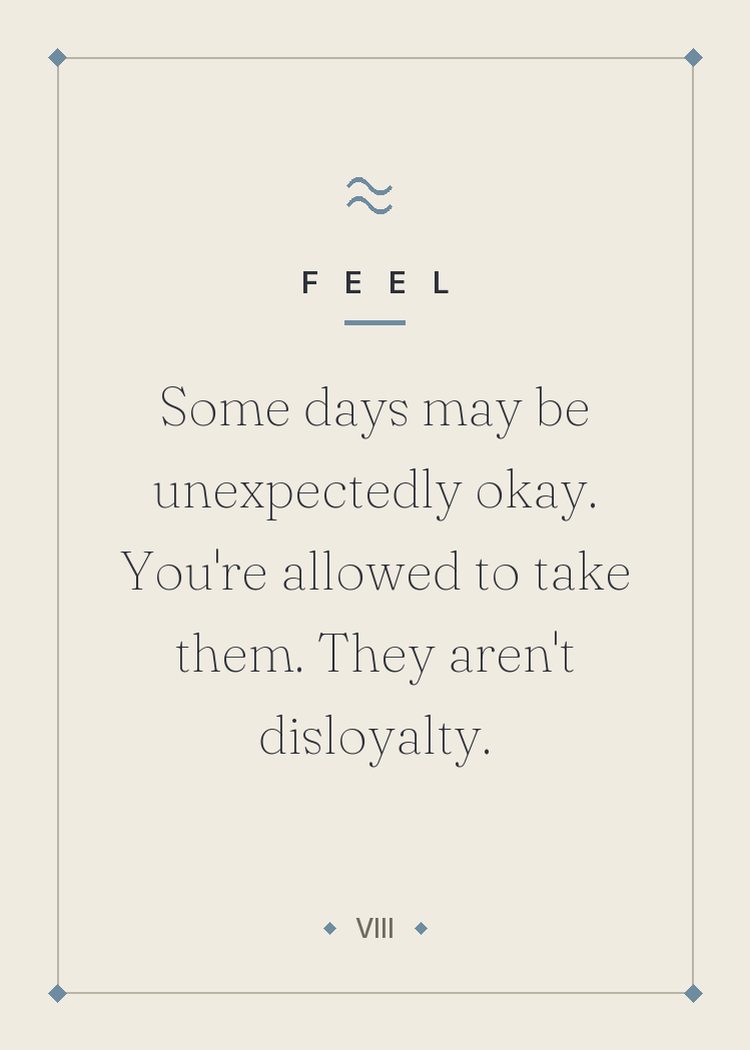
FEEL · VIII
In Stroebe and Schut's dual process model, healthy grief oscillates between loss-oriented time (feeling, missing, mourning) and restoration-oriented time (living, doing, even enjoying). The okay days are the restoration phase — a functional component of grieving, not a lapse from it. Systems that oscillate recover; systems locked in either mode struggle. Take the good days without auditing them. They are load-bearing.
Voices — this card, in use
Teaching vignettes: illustrative voices showing the practice applied. The living candle wall grows below.
Bea — 'first okay day came at week three and scared me. rest stop, not amnesia. took it without the audit. the road got easier to drive.'
Nate — 'good days used to feel like cheating on her. the science says the switching IS the healing. I clock out of grief some days now, guilt-free-ish.'
Whatever is coming up
This room is open every time — tonight, the anniversary, years from now. What's here right now?
The practice
Next okay day, do not audit it. Say once — 'this is a rest stop, and rest stops are part of the road' — then spend it fully, guilt suspended by order of the research.
When it's yours
If it's early daysThe first okay day often arrives absurdly early and triggers panic. It's oscillation, not amnesia.
If it's been a long timeEventually okay days become the norm punctuated by hard ones — the inversion is the healing, working as designed.
If it was complicatedRelief-tinged okay days after a complicated loss are doubly suspect to grievers. They're doubly legitimate.
Sit with this
What do you actually do on your okay days — and what would change if you trusted them?
Grief literacy
Term to know: Dual process model (Stroebe & Schut) — healthy grief oscillates between loss and restoration. The switching is the healing.
If this card holds you
This room doesn't expire. Grief isn't a one-time event — anniversaries, ambushes, the good years, the hard ones — and the card in your hand is a permanent key. Come back for whatever is coming up.
This card lives in the deck — 52 companions, on a nightstand near the people you love. Buy the physical deck — $35.00 · free US shipping