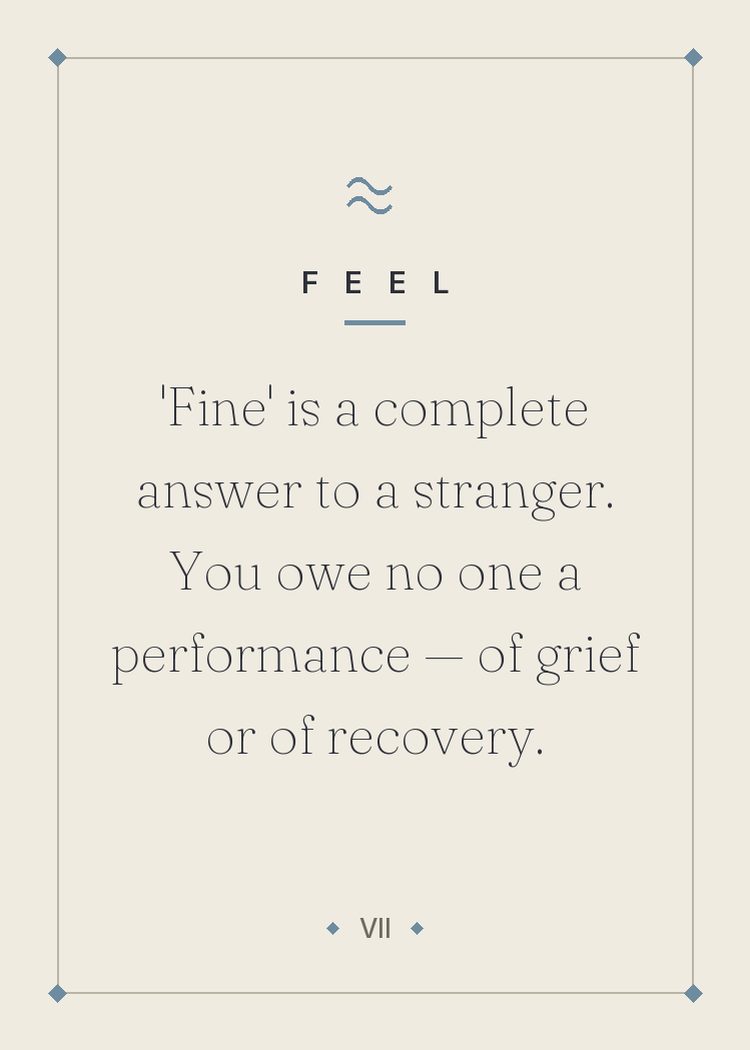
FEEL · VII
Grief research on social interaction documents a real burden: the pressure to perform — either enough sadness to seem loving or enough recovery to make others comfortable. Selective disclosure is the evidence-aligned boundary: full truth for chosen people, 'fine' for the checkout line. Managing information is not dishonesty; it is energy regulation. You owe your grief to no audience. The performance review is cancelled.
Voices — this card, in use
Teaching vignettes: illustrative voices showing the practice applied. The living candle wall grows below.
Keiko — 'two lists: truth people, fine people. three names on the first. everyone else gets getting through it. energy bill dropped instantly.'
Al — 'fine is a full sentence to the mailman. my brother gets the real answer. the card made that allocation official.'
Whatever is coming up
This room is open every time — tonight, the anniversary, years from now. What's here right now?
The practice
Sort your people into two lists: truth-people and fine-people. Today, give one truth-person the real answer and every fine-person the short one — deliberately, without guilt.
When it's yours
If it's early daysYou'll be asked 'how are you' fifty times this month. A rehearsed 'getting through it' protects the energy real grief needs.
If it's been a long timeUpdate the lists yearly. Some fine-people earn promotion; some truth-people retire. Both lists are allowed to change.
If it was complicatedComplicated grief especially deserves selective disclosure — most people can't hold the full story. Choose the two who can.
Sit with this
Who currently gets your truth by default rather than by choice — and is that allocation still right?
Grief literacy
Term to know: Selective disclosure — tiered honesty as energy regulation, not dishonesty.
If this card holds you
This room doesn't expire. Grief isn't a one-time event — anniversaries, ambushes, the good years, the hard ones — and the card in your hand is a permanent key. Come back for whatever is coming up.
This card lives in the deck — 52 companions, on a nightstand near the people you love. Buy the physical deck — $35.00 · free US shipping